Drywall Finish Levels Explained: Level 0 to Level 5
Drywall finish levels 0 to 5 explained: what each one means, which suits your paint sheen and lighting, and how to ask for it. Get a free estimate.
What Are Drywall Finish Levels?
Drywall finish levels are a scale from 0 to 5 that describes how much taping and joint compound a gypsum wall receives before paint or texture goes on. The scale comes from GA-214, Levels of Finish for Gypsum Panel Products, a document presented jointly by the Gypsum Association, the Painting Contractors Association and three other trade groups. A higher number means more finishing work, not better board.
The same document says it is not possible to achieve a perfectly flat surface, so every level is about concealing joints and fasteners, not erasing them. This guide explains what each of the drywall finish levels covers, which one suits your paint and lighting, and how to put it in writing. Texture styles and patch repair stay in our guide to drywall services in Southwest Florida.
What Do Drywall Finish Levels 0, 1 and 2 Include?
Level 0 is bare board. GA-214 says it is typically specified in temporary construction or whenever the final decoration has not been determined, with no taping, finishing or accessories required. Level 1 embeds tape in joint compound at the joints and interior angles. Excess compound and tool marks are acceptable and fastener heads need not be covered, which is why the standard points to places generally hidden from view, such as attics and the space above ceilings.
Level 2 wipes the joints with a knife, leaves a thin coating of compound over the tape and covers fastener heads and accessories with one coat. The standard lists it for walls that serve as a substrate for tile, and for garages and storage areas where appearance is not a concern. In a house, that usually means the wall behind tile or a utility space, not a living room.
What Separates Level 3 from Level 4?
Level 3 is built for walls that will receive a heavy or medium texture, sprayed or hand applied, or commercial grade wallcoverings. GA-214 adds one separate coat of compound over joints and interior angles and two over fastener heads and accessories. It also states plainly that Level 3 is not the correct finish for smooth walls or light textures.
Level 4 is the level the standard ties to smooth walls with flat paint. GA-214 calls for two separate coats over flat joints, one over interior angles and three over fasteners and accessories, and the surface must be smooth and free of tool marks. It also lists light textures and wallcoverings for Level 4, and says non-flat or dark paints are not recommended on it, which is where the next step up begins.
What Does Level 5 Drywall Add with a Skim Coat?
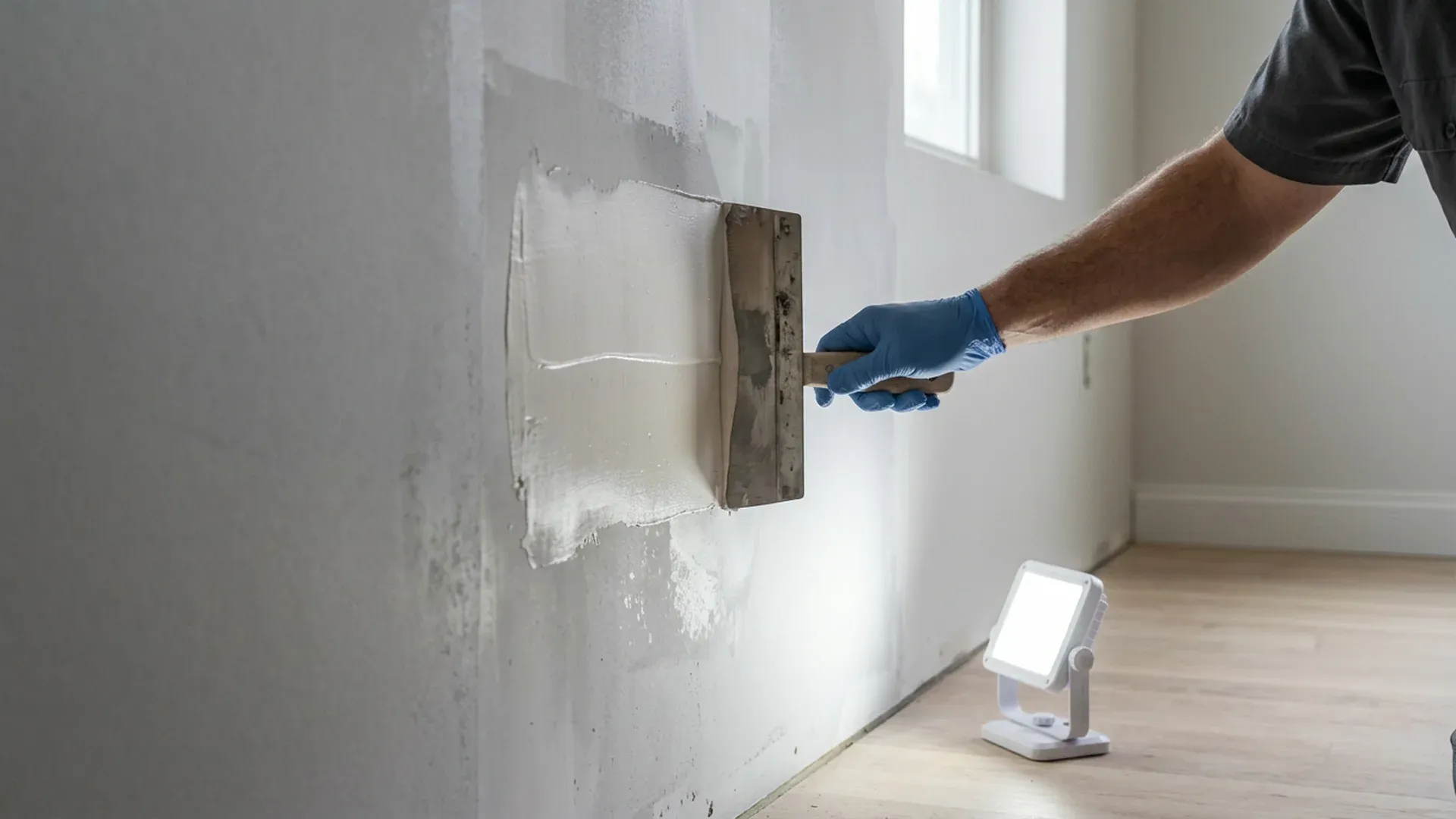
Level 5 drywall repeats the joint and fastener coats of Level 4 and adds one more step: a thin skim coat of joint compound, or a product made for the purpose, over the entire surface. National Gypsum's guide to the five levels describes the same final step. GA-214 calls this the most effective method to provide a uniform surface and minimize joint photographing, the faint outline of a seam, and fasteners showing through the final decoration.
The extra work is real. A skim coat is another full pass of compound plus drying time, so it belongs on walls where the paint or the light would reveal a Level 4 seam. It is not an automatic upgrade for every room in the house.
Which Drywall Finish Level Fits Your Paint Sheen?
Choose among the drywall finish levels by paint sheen and color depth, because glossier and darker paint exaggerates flaws. Under GA-214, smooth walls with flat paint point to Level 4, while non-flat paints, meaning anything with sheen or gloss, point to Level 5. The standard also lists dark or deep tone paints for Level 5. Its comments add that strong hues, even in flat paint, tend to magnify imperfections and raise the chance of joint photographing, and that a skim coat reduces the effect.
Heavy texture reverses the logic. If a wall will carry a medium or heavy texture, GA-214 matches it to Level 3, and paying for a full skim coat underneath adds little. Kitchens and bathrooms are where many owners choose a wipeable sheen, so those are the walls to raise with your contractor before the paint color is final.
How Does Lighting Change the Drywall Finish Level You Need?
Light that skims along a wall is hard on the lower drywall finish levels. GA-214 names critical lighting conditions as one of the reasons to specify Level 5, and its comments say a skim coat can minimize the effects when critical lighting cannot be avoided. In a Southwest Florida home, think of sliding doors that throw sun along the next wall, a hallway with a window at the far end, and fixtures that graze a wall from above.
The best test is simple. The inspection criteria in GA-214 use a normal viewing position at least five feet from the surface, under the lighting in place when the project is finished, and say blemishes should not be visible from that distance in normal light. Judge a wall from across the room, at the hour it looks worst, with the lamps on that you use every evening.
How Do You Ask for a Drywall Finish Level in a Scope?
Name the standard, the level and the room, then say what goes on top. A scope line such as "finish living room and hallway walls to GA-214 Level 4, flat paint" leaves no room for a different assumption. Add the sheen and color depth you plan to use, point out any wall that gets strong window or fixture light, and ask which level the estimate assumes for each area.
GA-214 also recommends a priming material before decoration, and for Levels 3, 4 and 5 it describes a jobsite mock-up that lets everyone agree on appearance before the full finish begins. On a home project, a finished sample section painted in your color and viewed in your light is a practical version of that idea. Taping and mudding, texture matching and paint-ready finishing are part of Phenomenal Renovation's drywall service, and no finish level is named on the service page, so ask which one your estimate assumes.
Drywall Finish Levels FAQ
What drywall finish level is standard for a house?
No single level fits every house. GA-214 ties each level to the final decoration. Smooth walls with flat paint point to Level 4, heavy texture points to Level 3, and sheen, dark color or harsh light point to Level 5. Your paint choice and your lighting decide the answer room by room.
Is Level 5 drywall worth it?
It is worth considering when the finish would otherwise reveal seams: non-flat paint, deep colors or strong light across the wall. GA-214 describes Level 5 as the most effective way to get a uniform surface. With flat paint and soft light, Level 4 may already meet your goal, so ask for a sample before deciding.
Can paint hide a low drywall finish level?
Not reliably. Paint follows the surface under it, and GA-214 says deep colors and even flat paints tend to magnify imperfections. It also says Level 3 is not the correct finish for smooth walls. Settle the finish level first, then prime and paint, because touch-ups over a finished wall are hard to conceal.
Do drywall finish levels apply to ceilings?
Yes. GA-214 covers both walls and ceilings, and its comments name critical lighting as a reason to go higher. A ceiling that catches light from a window or a long hallway fixture can show joints that a wall would hide. Name each ceiling in your scope the same way you name the walls.
Plan Your Drywall Finish in Southwest Florida
Bring your paint choice, a photo of the room and a note about where the light comes from. Start from Phenomenal Renovation's drywall service page, then phone (239) 878-3404 for a free estimate and ask which of the drywall finish levels it assumes for each room. Still choosing sheen and color? Our overview of interior and exterior painting in Southwest Florida covers the painting side.
Guidance on drywall finish levels checked against the Gypsum Association's GA-214 publications page and the GA-214-2021 text in November 2026.
Cristiano Barbosa is the Founder & CEO of Phenomenal Renovation, a family-owned remodeling company serving Fort Myers, Cape Coral, Naples, Bonita Springs, Estero, and LaBelle. With over 20 years of hands-on experience and two generations of construction knowledge behind him, he holds both a Certified Residential Contractor (CRC) license and a Licensed Plumber license, letting his crew handle plumbing and waterproofing in-house instead of outsourcing it, and has led his team through more than 350 successful renovations across Southwest Florida.